A space elevator is a fixed structure, typically a cable held taut between a spinning planet and a mass beyond geostationary orbit, that lifts cargo and people into space without burning rocket fuel. Engineers have taken the idea seriously since the 1960s, waiting on a cable material strong enough to bear its own weight across tens of thousands of kilometers. These five novels, spanning five decades, treat that structure as the central fact of their worlds rather than as scenery.
The Fountains of Paradise by Arthur C. Clarke (1979)
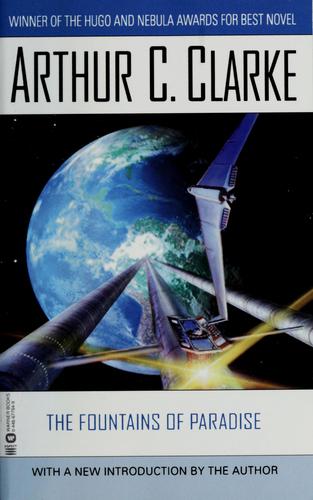
Engineer Vannevar Morgan wants to build humanity’s first orbital tower, a structure running from the equator to a station in geostationary orbit, on the fictional island of Taprobane, a thinly veiled stand-in for Sri Lanka. His chosen site sits on a mountain already occupied by a Buddhist monastery, and Clarke spends much of the novel on the political and personal negotiation needed to clear the ground before a single cable can be spun. When construction finally succeeds, an accident traps workers on the unfinished structure, and Morgan’s rescue climb costs him his life just as the tower he dreamed of starts operating.
The elevator here is not a shortcut to a bigger adventure; it is the adventure. Clarke builds the entire plot around the engineering sequence of siting, funding, and constructing the tower, using a “hyperfilament” of continuous crystalline carbon to solve the material-strength problem that stalls the concept in reality. The novel treats the tower’s economics and physics with the same seriousness it gives Morgan’s personal ambition, so that the structure’s completion functions as both the climax and the point of the book.
Clarke wrote an open letter, printed at the end of Charles Sheffield’s The Web Between the Worlds, after discovering that Sheffield had independently written a near-identical premise the same year, down to an engineer nicknamed after a wizard and a construction machine called “Spider.” He called it an idea whose time had come rather than a coincidence either writer should worry about. Clarke also spent his later career as a public advocate for the real technology, telling the 1979 International Astronautical Congress in a line he credited to physicist Arthur Kantrowitz that the space elevator would be built about fifty years after everyone stopped laughing at it.
The Web Between the Worlds by Charles Sheffield (1979)
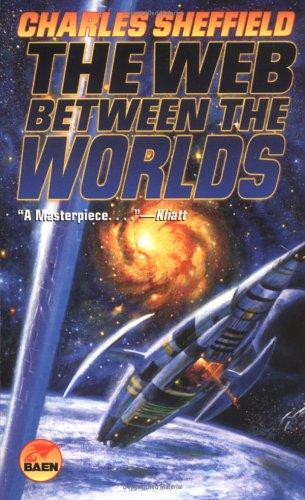
Rob Merlin, a brilliant and unconventional engineer, is recruited by the reclusive industrialist Darius Regulo to design a space elevator that will replace the wasteful rocket transport Regulo’s mining empire depends on. While the tower rises, Merlin becomes suspicious that his parents’ deaths years earlier were not the accident he was told, and his investigation puts him in danger from people close to Regulo himself. The engineering project and the personal mystery advance together, each raising the stakes on the other.
Sheffield gives the elevator a distinct material logic from Clarke’s: Merlin adapts a machine called the Spider, originally built to extrude graphite cable, to spin pure crystalline silicon strong enough to hold the structure’s own weight. Regulo’s argument for the tower is coldly economic, since half of a rocket’s fuel exists only to lift the other half, and the elevator promises to eliminate that waste entirely. The device is therefore both an engineering puzzle Merlin must solve and a business weapon in Regulo’s monopoly over space mining.
Sheffield brought direct professional expertise to the material problem he gave Merlin: he held a mathematics and physics degree from Cambridge and worked as Chief Scientist at Earth Satellite Corporation, consulting for NASA on remote-sensing systems, before and during his fiction career. When Clarke’s near-identical novel appeared the same year, Sheffield and Clarke treated the overlap as a coincidence that amused them both rather than a dispute over priority, each crediting the same emerging engineering literature on tether structures for pointing two physicists-turned-novelists at the same design.
Red Mars by Kim Stanley Robinson (1992)

Robinson’s novel follows the first hundred colonists sent to settle Mars, a group split from the outset over how far the planet should be transformed to support them. Their political and ecological argument over terraforming runs alongside the practical work of building a livable colony, including a space elevator anchored to the Martian equator that becomes the planet’s main link to Earth and its markets. The elevator’s fate is bound up with the colony’s, since both are creations of an uneasy alliance between idealistic scientists and the transnational corporations funding them.
Where Clarke and Sheffield write the elevator’s construction as triumph, Robinson writes it as a piece of contested infrastructure that a settler society can lose. The Martian tower is built to move immigrants and cargo cheaply enough to make large-scale settlement possible, tying the fortunes of ordinary colonists to a single vulnerable structure. When the political order that built it collapses into open conflict later in the novel, the elevator becomes a target rather than a monument, and its destruction marks the end of the first Martian republic as clearly as any battle does.
I did not find a statement in which Robinson discusses the Martian space elevator specifically, so I will not attribute that reasoning to him. What is on record is that he has continued to treat elevators as necessary infrastructure in his later solar-system fiction: discussing his 2012 novel 2312, he said space elevators and self-replicating machinery are the two postulates that make his imagined futures work as realistic extrapolation rather than fantasy, adding that real companies are already pursuing the technology.
Pillar to the Sky by William R. Forstchen (2013)

Set in a near future where a stalled space program has left the public skeptical of any large government project, married scientists Gary and Eva Petrenko team up with an eccentric entrepreneur to build a space elevator using breakthrough carbon nanotube cable. Facing government indifference and outright sabotage from rivals who see the project as a threat, the team relocates their effort to international waters near the equator to escape regulatory roadblocks. The novel follows the elevator from a barely funded research idea through the political fight required to see it actually built.
Forstchen treats the tower as a direct, practical fix for a specific economic problem: the enormous cost per pound of reaching orbit by rocket. The book spends real attention on the material science of the cable and the logistics of anchoring a structure to a floating equatorial platform, presenting the elevator less as a marvel than as an infrastructure project that a sufficiently motivated coalition of scientists and investors could complete within a generation. Its central conflict is institutional rather than technical, pitting the builders against entrenched aerospace interests who profit from the costly status quo.
Forstchen has said the novel began with his own encounter with Clarke’s original: “It started for me when I read Arthur C. Clarke’s Fountains of Paradise,” which he called the first novel to take the engineering of a space elevator seriously, and he described the idea staying with him for more than three decades before he wrote his own version. He has also argued for the technology directly in his own voice, stating that an elevator “reduces the cost from thousands of dollars a pound to dollars a pound” and calling it the transportation system he expects to define the twenty-first century.
The Highest Frontier by Joan Slonczewski (2011)

Jennifer “Jenny” Ramos Kennedy, the descendant of a famous political dynasty and a survivor of an alien-organism attack that killed her twin brother, leaves an ecologically ravaged Earth to attend college at Frontera, a habitat orbiting the planet. Getting there means riding a space elevator up from the surface, one piece of a setting where climate collapse, invasive alien life, and campus politics all press in on Jenny’s freshman year at once. The novel follows her adjustment to a habitat that is as much a fragile ecosystem as it is a school.
Slonczewski gives her elevator a biological mechanism rather than a purely mineral one: the cable material in Frontera’s world is grown using microbes engineered from dangerous pathogens, repurposing organisms once linked to anthrax and AIDS into cable-producing biotechnology. That choice folds the tower into the novel’s larger interest in living systems doing engineering work, consistent with a book where the orbital habitat itself is described as enclosed in a microbe-filled water layer that keeps the whole structure running. The elevator is therefore continuous with Frontera’s biology rather than a separate mechanical intrusion into it.
I did not find a statement in which Slonczewski discusses the space elevator in The Highest Frontier specifically, so I will not put that reasoning in her voice. What is verified is her professional background: she has been a microbiologist at Kenyon College since 1984, holds a doctorate in molecular biophysics and biochemistry from Yale, and has built a body of hard science fiction, including A Door into Ocean and Brain Plague, that consistently derives its speculative technology from working biology rather than physics or chemistry alone.
Explore Related Ideas
- 5 SFF Books About Dyson Spheres and Dyson Swarms
- 5 SFF Books About Terraforming
- 5 SFF Books About Uplifted Animals
- 5 SFF Books About Generation Ships
- 5 SFF Books About Post-Scarcity Societies
- 5 SFF Books About Sentient Trees
- 5 SFF Books About Mind Uploading as Death
- 5 SFF Books About First Contact as Colonial Encounter